
AI is much bigger than a chatbot
When someone says artificial intelligence, a chatbot might be the first thing you picture. That is understandable, but AI is a broader field that includes systems designed to recognize patterns, interpret language, make predictions, and create new content. Everyday examples include spam filters, voice recognition, visual search, document processing, and tools that help categorize customer questions.
The important question is not whether a system feels intelligent. It is what task the system is designed to perform, what information it uses, and how its performance will be evaluated. Once you ask those questions, the buzzwords become much less intimidating. You can judge whether a proposed AI feature is useful rather than accepting every product demonstration at face value.
Machine learning finds patterns
Machine learning is one way to build AI. Instead of programming a separate instruction for every possible case, developers train a model using data. Imagine showing a model examples of emails labeled as appointment requests, billing questions, or technical problems. After training, the model might predict the category for a new message. That prediction is based on learned patterns, not human understanding.
Teams commonly divide data for training and evaluation so they can measure how the model performs on unfamiliar examples. The quality and representativeness of the data matter. A system that performs well for one group may perform poorly for another. That is why accuracy, fairness, and error analysis belong in the conversation from the beginning.
Generative AI creates new content
Generative AI can draft text, produce images, suggest code, or create other material using patterns learned during training. A large language model, or LLM, is a type of model designed to work with language. A prompt is the instruction or context you provide. Clear prompts often help the result match your purpose, especially when you specify the audience, source material, and desired format.
Fluent language does not guarantee a correct answer. A model may invent a source, overlook a requirement, or produce a confident explanation that contains an error. Use the output as a suggestion or draft when appropriate, and verify important claims independently. For high-impact decisions involving safety, employment, health, benefits, or finances, human accountability remains essential.
Why cloud skills matter to AI
Many AI systems rely on cloud services for data storage, computing capacity, hosting, monitoring, and application integration. A simple website that sends questions to an AI service still needs identities, network rules, cost controls, data handling policies, and reliable software delivery. That means traditional cloud skills remain relevant even when the application looks new and exciting.
An architect may decide which services communicate, a developer may build the user interface, a security specialist may restrict access, and an educator may help people use the tool effectively. You do not need to become a machine-learning researcher to contribute to an AI project. Understanding the overall workflow is valuable in its own right.
Example: answering community class questions
Imagine a community program that receives repeated questions about registration, required devices, class locations, and schedules. An approved AI tool could help staff draft responses from a reviewed FAQ. A practical workflow would retrieve the relevant class information, ask a model to produce a clear answer, and check that answer before sending it to a learner.
One technique called retrieval-augmented generation, or RAG, supplies the model with relevant external information while it drafts. This may improve relevance and traceability, but it does not eliminate mistakes. Dates may change, documents may conflict, and a response can still be incomplete. Someone must own the source information and decide when an answer requires escalation.
Responsible AI protects people
Responsible AI involves more than avoiding embarrassing mistakes. Teams should consider privacy, reliability, safety, transparency, fairness, security, and accountability. NIST's AI Risk Management Framework offers guidance for evaluating and managing these risks throughout a system's lifecycle. These concerns affect whether an AI feature is genuinely useful for the people it is supposed to serve.
Before sharing confidential material with an AI service, check the organization's policy and understand how the service handles data. Avoid uploading private student, customer, or employee information without authorization. Test the solution for different audiences and scenarios. A technology that works beautifully in a demonstration may still exclude people with different needs or produce unreliable results in ordinary use.
Try two simple experiments
First, copy a small amount of public information about a sample event and ask a generative AI tool to turn it into a friendly checklist. Compare every detail against the original information. Mark what the tool got right, what it left out, and anything it invented. Rewrite your prompt and see whether the result improves. This exercise teaches prompting and verification together.
Second, practice a classification task by labeling a handful of imaginary customer questions. Decide which categories make sense and where ambiguous messages should go. Compare that with asking a model to draft responses. You will see the difference between predicting a category and generating content, which is an important distinction for planning real solutions.
The takeaway
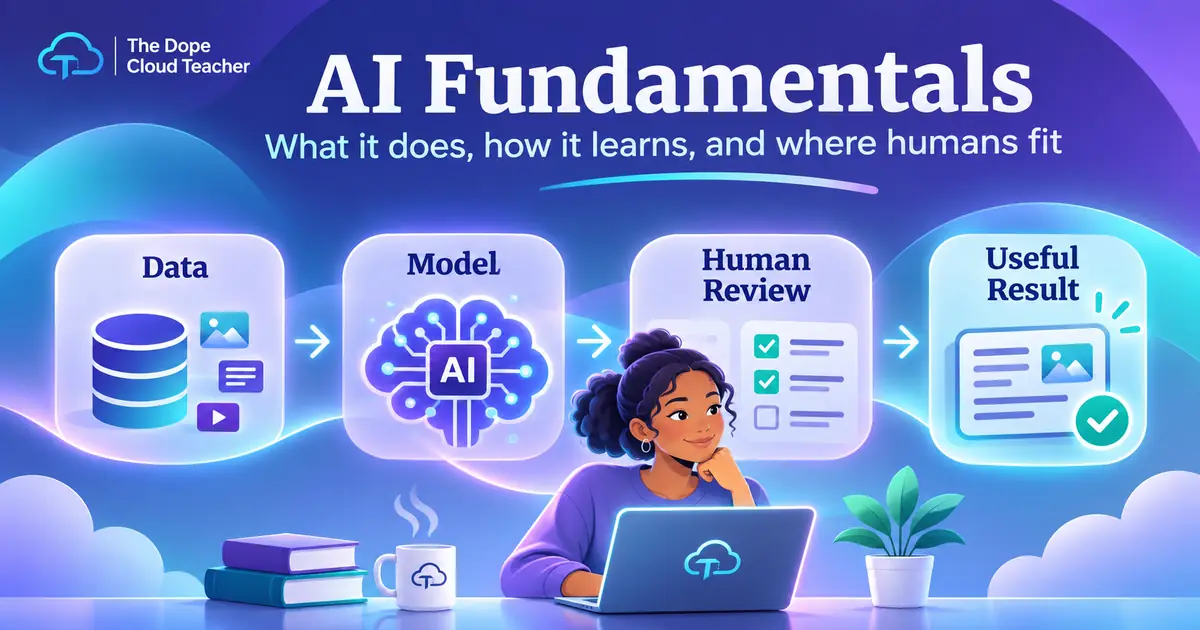
You can begin learning AI without memorizing a thousand algorithms. Learn what the technology is meant to do, identify the role of data, evaluate the result, and decide where human review belongs. Security and responsible use are part of the foundation, not advanced topics reserved for later.
AI should make people more capable, not less thoughtful. Build the habit of testing small use cases, asking good questions, and checking the output. That confidence is a practical technology skill, and it belongs in classrooms, community centers, businesses, and everyday life.